When that magical dream of business leadership arrives, whether it be as an owner or part of the leadership team, your role just got bigger. Not because you are in charge of a business or a department, but because you are now part of the organization’s sustainability mechanism. People and culture are now more dependent on you to perform at peak levels. As the saying might go, you have families to feed, clothe, and make prosperous.
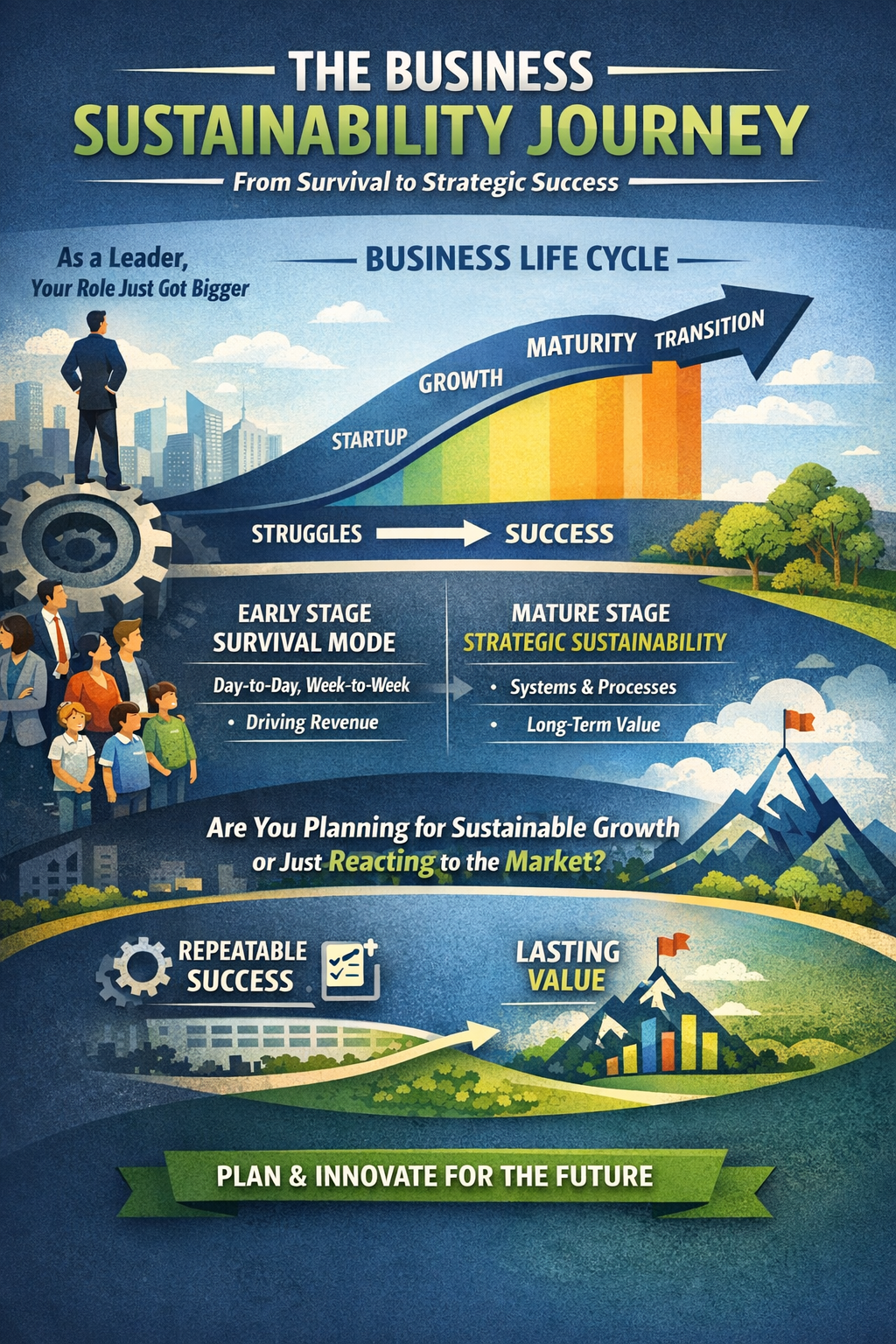
A business, like any organism, has a life cycle. It starts, matures over time, and is eventually perpetuated either internally as a rebirth or externally by being sold to another business of the same type. During this business life cycle, the business will have its moments of struggle and glory. Determining how long each of those phases lasts depends on how leaders see the value of sustainability as a strategy, not just an outcome.
In this context, we are not referring to sustainability in terms of specific operational practices considered kind to natural resources or the environment. These are very worthwhile efforts a business can incorporate into how it operates, but sustainability, as viewed in terms of the business’s value, is far more about being strategic in its actions than simply reacting to the marketplace.
During the initial phases of a business, survival is the only strategy in play. Doing whatever it takes to capture revenue from the products or services offered, and repeating on an ever-increasing scale to grow and expand, making the business viable to sustain costs and realize future potential profit. Sustainability at that point in time is day-to-day, week-to-week, and, over time, monthly, quarterly, and annually.
Once the business is living in its mature state, sustainability must become far more strategic than just all hands on deck. Sustainability requires systems, processes, and procedures to support the business’s deliverables. Sustainability needs a solid foundation and framework – your culture – to attract the best talent, customers, and vendors.
Sustainability is very closely related to repeatability. How well does your organization have the capacity to replicate top-shelf, best-quality in each iteration of the product and services offered? Is the organization strategically planning for growth and expansion in a way that incorporates past best practices while refining and improving them to support future potential?
Being able to demonstrate to the marketplace your ability to replicate your best contributions of the past while simultaneously expanding on innovative offerings allows not just for additional revenue but for the sustained repetition of those revenue activities over time. This recurring cycle of strategic growth builds confidence not only in the marketplace but also with your staff. They have confidence in their leadership to recognize the value they bring and, as a result, are rewarded with solid, continued employment in a great culture.
This week is the opportunity to look at the value your business brings by being sustainable into the future. People want to be part of something exciting and growing, and to contribute to that outcome. Are you strategically looking for ways to be sustainable or simply reacting with just more of the same? The marketplace is moving farther and faster than you think, so you must be planning a strategy to stay with it or just ahead of it.
Need a strategist to ask you the tough questions and then hold you accountable? Give JKL Associates a call and speak to a Promise Guide about your options. MI (313) 527-7945 or FL (407) 984-7246.
Journey On!
COPYRIGHT – JKL ASSOCIATES 2026
QUESTIONS OR COMMENTS – EMAIL US AT PARTNERS@JKLASSOCIATES.COM OR CALL OUR OFFICES – MI AT (313) 527-7945 FL AT (407) 984-7246
Celebrating 30 years of Delivering on “Promises”

