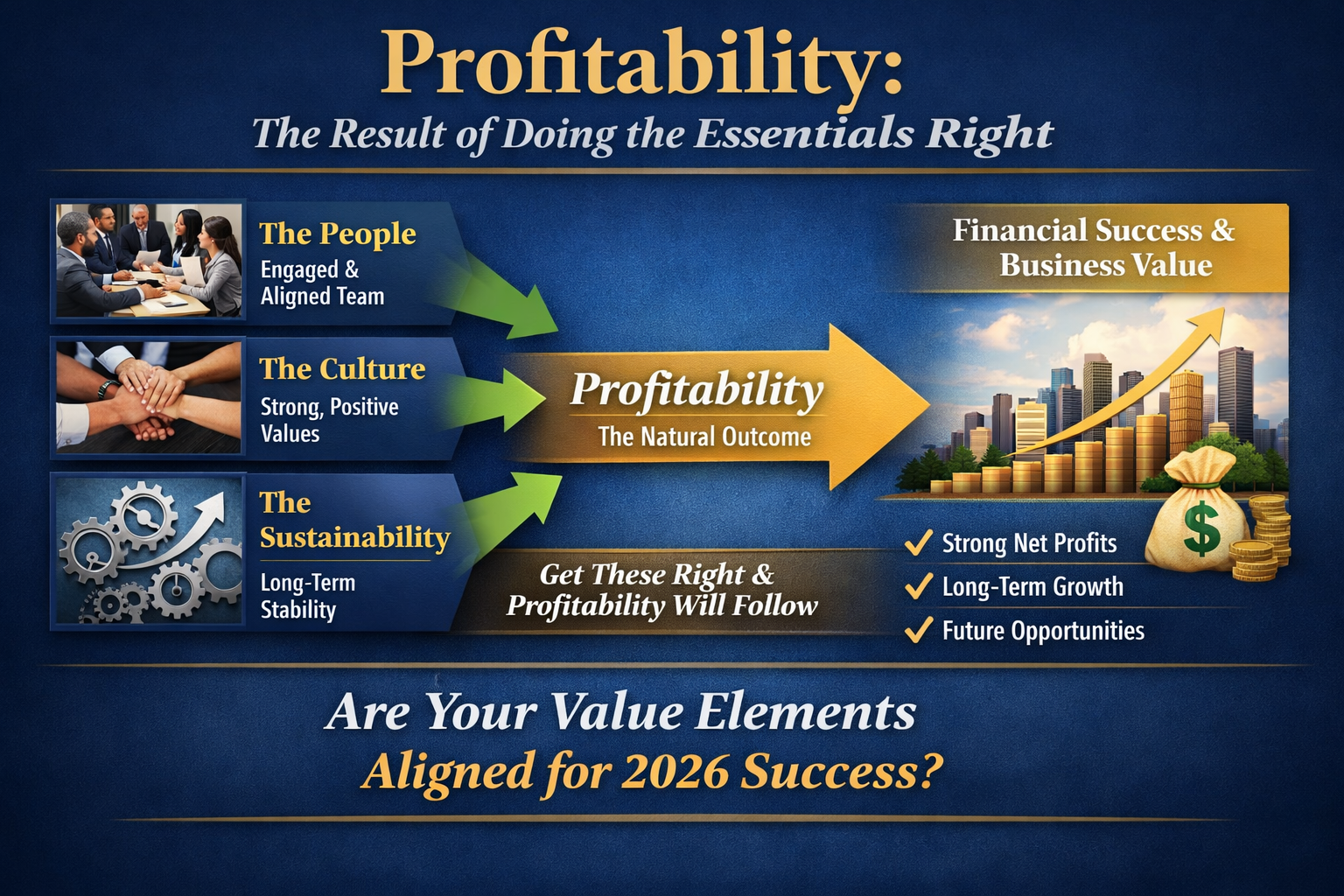
For the past few weeks, we have been exploring the value elements of your business – The People, The Culture, The Sustainability, and today we look at The Profitability. We specifically kept this element for last for a couple of reasons. The first and possibly the most important one is that the value of your business – its profitability will naturally flow from getting the first three elements in place and done well. The profit of your business is the result of doing the other elements first. The second reason is that when a leader is asked why they are in business, a typical response is that they are in business to make money. Although this is not an incorrect statement, the money only comes when all other parts of the business are operating at their very best.
If the people in the organization are not well aligned with and committed to the business’s culture and direction, you will face an uphill battle to retain and develop your team. Likewise, if your culture is haphazard and not lived daily, disarray will spread throughout the organization, jeopardizing sustainability.
This brings us back to profitability. This is not the end goal; it needs to be the outcome of having a business foundation, framework, best talent, and aligned systems and processes in place. When the focus is only on profit, the path to getting there can be a shortcut, leaving many parts of the organization broken. This impacts sustainability, which in turn causes profitability to falter.
We cannot ignore the fact that your organization’s profitability is critical to building the business’s long-term net financial value. The business is likely a key financial asset in a leader’s portfolio; thus, the greater its profitability, the greater its value when it is perpetuated to employees, family, a third-party buyer, etc. Given that this is part of the business development strategy, we need to keep our metrics aligned with future objectives. Businesses, when transitioned to future ownership, use various methods to establish a value and thus an offering price for the purchase. All of the methods use a combination of the value elements we have explored. Profitability, or the ability of the business to generate not just revenues but net bottom-line profit, is definitely a key element of the financial transaction. When considering the other elements of people, culture, and their ability to sustain recurring value, interest in the asset can increase or be a deciding factor for one business asset over another.
This week, revisit the 4 value elements explored during the month of July. What strategic actions do you need to put in place for the remainder of 2026 to position your organization for its best performance? Who in your organization do you need to enlist to champion each of these value elements so they are not just present but aligned and alive in daily efforts and decision-making?
Maybe it is time to enlist a Promise Guide to be on the journey with you and your team to achieve your greatest outcomes. Give JKL Associates a call and let us start a conversation on your needs and wants. Call us at MI (313) 527-7945 or FL (407) 984-7246.
Journey On!
COPYRIGHT – JKL ASSOCIATES 2026
QUESTIONS OR COMMENTS – EMAIL US AT PARTNERS@JKLASSOCIATES.COM OR CALL OUR OFFICES – MI AT (313) 527-7945 FL AT (407) 984-7246
Celebrating 30 years of Delivering on “Promises”

