
It is a given in business. We need customers, and they need our products and services. This transactional relationship is the basis of commerce. A situation or need exists, and a vendor provides an answer. It can be a product or a service, depending on the customer’s requirements. In this transaction, the level of the relationship depends on the parties involved in the transfer of goods and/or services.
Some relationships are purely transactional and may happen infrequently. Other relationships recur time and again and lead to different levels of engagement. It is these relationships that are key to the growth and sustaining cash flow of the business.
The question remains: are you prioritizing the relationships with these key recurring customers and the financial transactions the parties select to participate in?
Some steps to approach getting an understanding of your best customers.
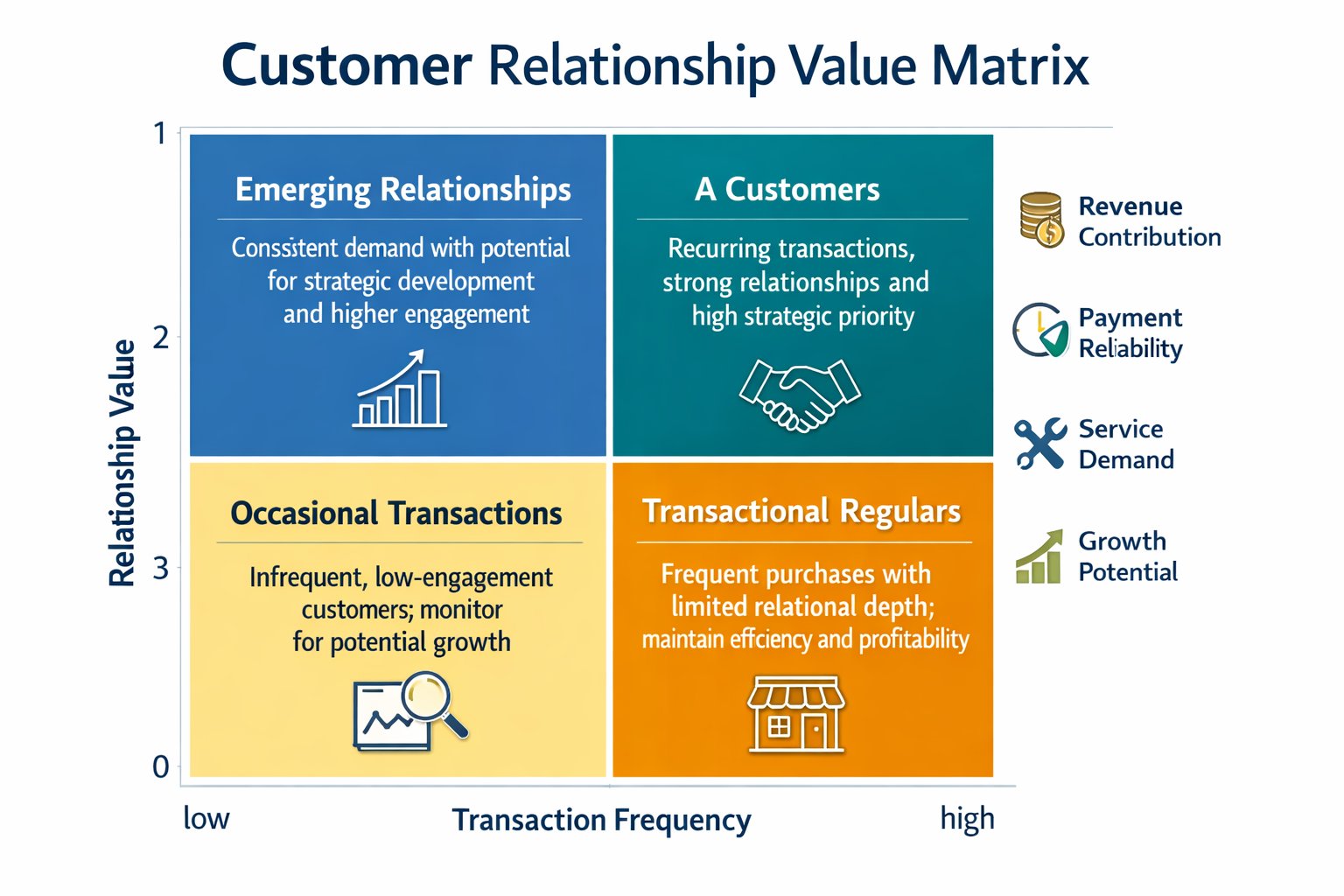
Each client of JKL Associates that uses a matrix to classify its customers has its own unique criteria for identifying what makes a great or best customer for its organization. Here are a few criteria some have used to build their client matrix.
Most start by getting a profile of the actual revenue the customer transacts with the business over some cycle of time, such as annually, and they look at the recurrence or trend over the past few years. They will also toss out any anomalies which might have happened due to a singular event taking place (such as years during COVID19). They will begin to rank these into categories of “A,” “B,” “C,” etc. Typically, the Pareto Principle holds that 80% of revenue comes from about 20% of the customer base. These might very well be your top customers.
These customers need further investigation to truly establish them as the top priority for your business. You should also look at the terms of payment. Are they timely, or are you financing their business with payments that are continuously delayed to your business? Not only is the money late, but your staff also needs to constantly reach out and follow up to get paid, taking them away from other opportunities.
You also need to get a handle on the demands they place on your organization. Are they constantly asking for extra service capability (quicker, more “Free” add-ons, etc.) Many times, because they are a major revenue contributor, their stuff gets escalated, putting others’ work behind them, yet the actual profit on the product or service remains the same or, in many cases, is less than that of other business opportunities.
Another criterion to consider is which of the “B” level customers could become an “A” level customer if they were engaged more specifically to demonstrate your organization’s capability to meet their demands.
These should get you started on refining not just which customers are or should be high priority, but also ensuring that all of your staff is aware of the reasons these customers receive the prioritization they deserve.
It may seem daunting to get a handle on your customers with a defined, criterion-based approach, but in almost every situation where a client has done this, they discover key insights into what they thought and what actually constitutes a high-priority customer.
Looking to implement a client priority approach? Give JKL Associates a call and speak to a Promise Guide about your options. FL – (407) 984-7246 or MI – (313) 527-7945.
Journey On!
COPYRIGHT – JKL ASSOCIATES 2026
QUESTIONS OR COMMENTS – EMAIL US AT PARTNERS@JKLASSOCIATES.COM OR CALL OUR OFFICES – MI AT (313) 527-7945 FL AT (407) 984-7246
Celebrating 30 years of Delivering on “Promises”

