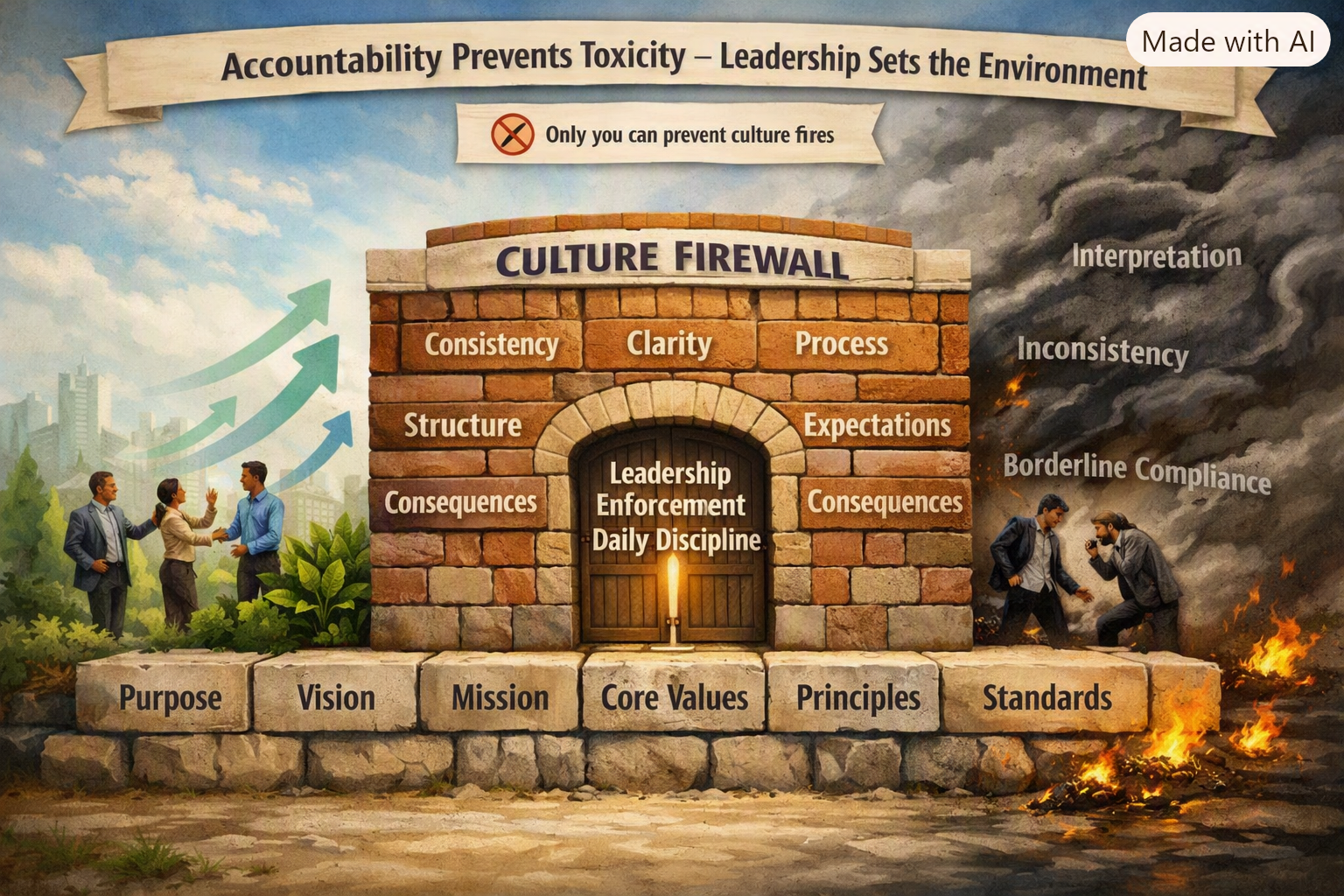
Contrary to popular social perception, holding others accountable and being accountable is not toxic. Granted, some individuals prefer a fly-by-the-seat-of-their-pants approach and do not see rules, laws, and standards as guidance systems to operate within. As we live in a representative republic in the United States and many liberties and freedoms abound, this area of responsibility and accountability has tended, especially in the past few years, to be highly subject to individual interpretation. These personal interpretations may play out in society, but within the realm of your business, the overarching framework of purpose, vision, mission, core values, principles, and standards is not subject to individual interpretation.
Your organization’s culture is the overall environment in which toxicity or growth exists. As leaders, our role is to provide an environment that cultivates growth not only for the organization but for each individual who contributes to that directive. Part of helping individuals grow in today’s business and personal environment is to provide process and structure. Help form productive discipline so recurring contribution can be a productive result.
This is far easier to state here in a written insight than to deliver day in and day out with your organization. Many factors affect how a culture operates or becomes dysfunctional. Even the most prestigious organizations known for their culture still face challenges that need constant refinement.
When the talent marketplace becomes very challenging to find, recruit, and hire talent, this area of culture, environment, standards, etc. can sometimes drift into a less-than-ideal state of continuity. This is where the marketplace brings the word toxic into the conversation.
A new hire enters the organization, and the culture does not enforce the organization’s environment and standards from day one. Not only does this individual start down a broken road, but they also bring along others already in the business who are borderline compliant. When things go sideways and leadership steps in to bring things back into alignment, this group of resources feels singled out and would rather leadership own the issue; thus, the culture is said to be toxic.
These references are not completely incorrect. As business leaders (regardless of duties, responsibilities, etc.), it is everyone’s responsibility to uphold the culture and hold it accountable to the standards defined in the organization’s overall framework. When we live each day, each customer interaction, and each deliverable by these foundational elements, the culture thrives. Individuals who are out of alignment will realize the consistency of the environment and elect to align or leave.
This week, as you assess your organization’s direction, performance, culture, etc., be ruthlessly honest with your observations. Are you true to your culture framework, and are you engaging your leadership team to be the same? As Smokey the Bear would say – Only you can prevent forest fires – and as leaders, only you can set the culture to avoid a toxic environment.
Looking to upscale your organization’s culture? Reach out to a Promise Guide for an initial conversation on how JKL Associates can help. Call MI (313) 527-7945 or FL (407) 984-7246
Journey On!
COPYRIGHT – JKL ASSOCIATES 2026
QUESTIONS OR COMMENTS – EMAIL US AT PARTNERS@JKLASSOCIATES.COM OR CALL OUR OFFICES – MI AT (313) 527-7945 FL AT (407) 984-7246
Celebrating 30 years of Delivering on “Promises”

