
For many leaders, when they initially assume their role, they believe they have a pretty good vision or, should it be eyesight. Their many years of investing time and energy, and overcoming numerous obstacles, have finally paid off in a leadership role. During this time of growing themselves and keeping their head down while pushing forward, they might not have realized their eyesight could very well be hindered. They might just need corrective lenses to reach the next higher level of contribution as a leader.
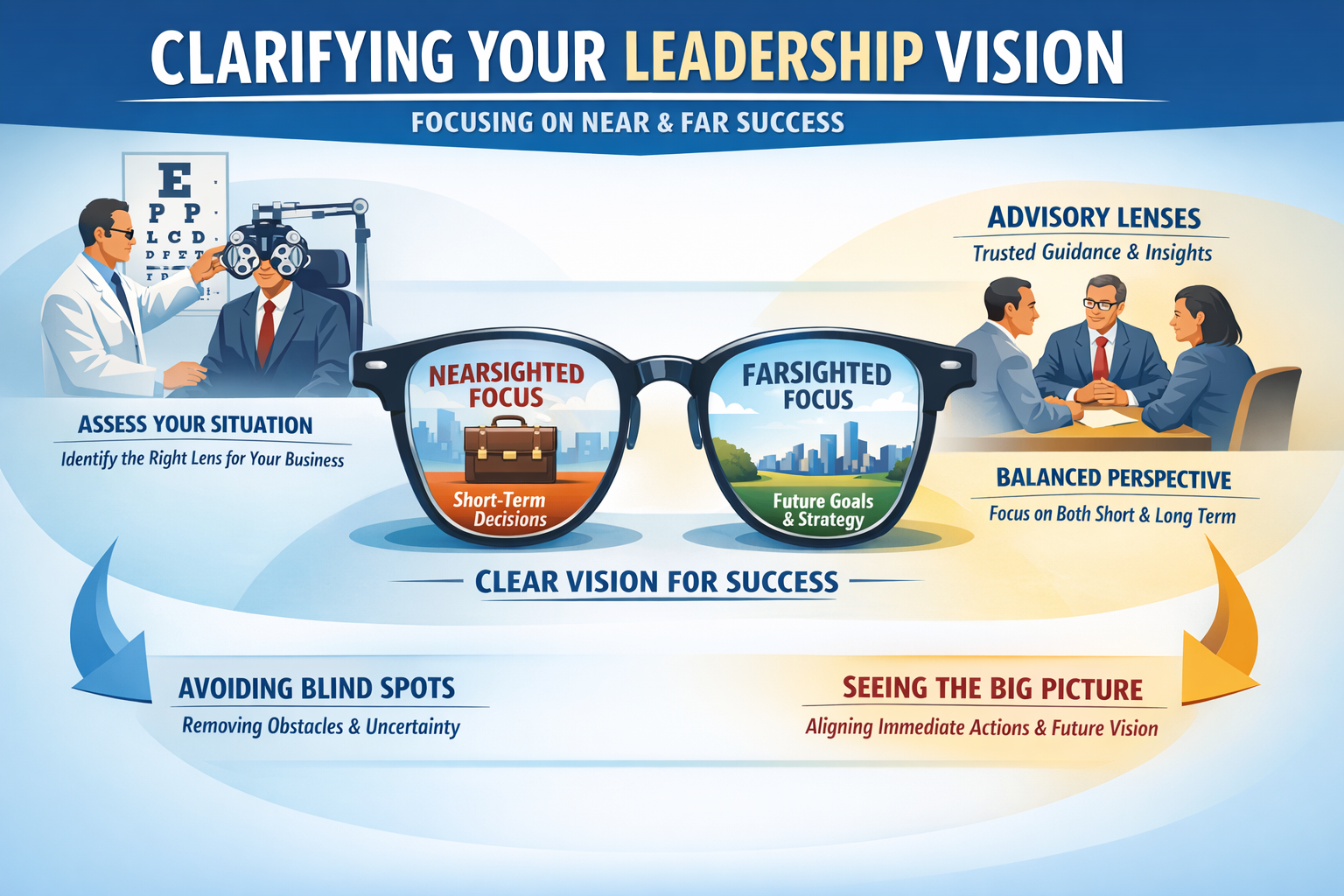
If you have and wear glasses or contact lenses, or have had an annual eye examination (which should be part of your annual self-investment, such as a physical), then you know the value and benefit of placing a corrective mechanism on your vision to enable you to see better. The process the doctor uses when checking your eyes for the appropriate level of correction or adjustments is to switch out different lenses, and you acknowledge the level of clarity each provides. This narrows in on the best perspective lens for your particular situation.
As a leader in your organization, this method of identifying the best corrective actions and then taking action steps is much like visiting a doctor for an eye exam. Your eye chart is not hanging on the wall with various letters. It is a business situation involving people, customers, and deliverables. The biggest difference is that your re-examination of the organization’s situation is not an annual event. It could very well be hourly, daily, or some other cycle of need.
Much like your eyesight, if you are nearsighted in your leadership role, you could be so focused that you see only what is right in front of you or close by, giving less attention or energy to future situations. Not seeing the downstream impact of a short-term or close-up decision. Conversely, if your view is farsighted, you are looking to the future and missing the very thing right in front of you.
In the business world, we often reference great leadership as having a crisp vision of the future. This is very valuable and, for the most part, true. The key here is that leaders with great future vision likely have a set of lenses that also help them bring the short term into clear view as well. The long-term vision of the business is farsighted, but the daily implementation and execution takes on a nearsighted approach.
Part of being in a leadership role is having a trusted advisor council or, in the case of your actual business vision, a set of advisory lenses to bring the best sight into play to grow your business. The advisory can help clear the blur in a situation or, in some cases, remove the blockage or impediment from your eye altogether. We all need to have access to the best resources to make the most effective business decisions. Our view of current and future challenges is not an exception to this need.
This week, as you ponder how good your view of your business is and what its future potential can be, consider if your vision is farsighted or nearsighted, or if you are using the necessary corrective lenses to view your future.
A JKL Associates Promise Guide is an excellent member for your trusted advisory council. An additional set of lenses to view your business dynamics and give insights into options for the best outcomes. Give JKL Associates a call at FL (407) 984-7246 or MI (313) 527-7945 and start the conversation by sharing your view of the future.
Journey On!
COPYRIGHT – JKL ASSOCIATES 2026
QUESTIONS OR COMMENTS – EMAIL US AT PARTNERS@JKLASSOCIATES.COM OR CALL OUR OFFICES – MI AT (313) 527-7945 FL AT (407) 984-7246
Celebrating 30 years of Delivering on “Promises”

