Most organizations have processes in place to monitor how the business is running. Data is entered into a financial system that allows you to generate a profit and loss statement, balance sheet, and even some budget reports. For the most part, these monitoring tools, while important for understanding what happened, are not ideal for seeing where the business is currently heading.
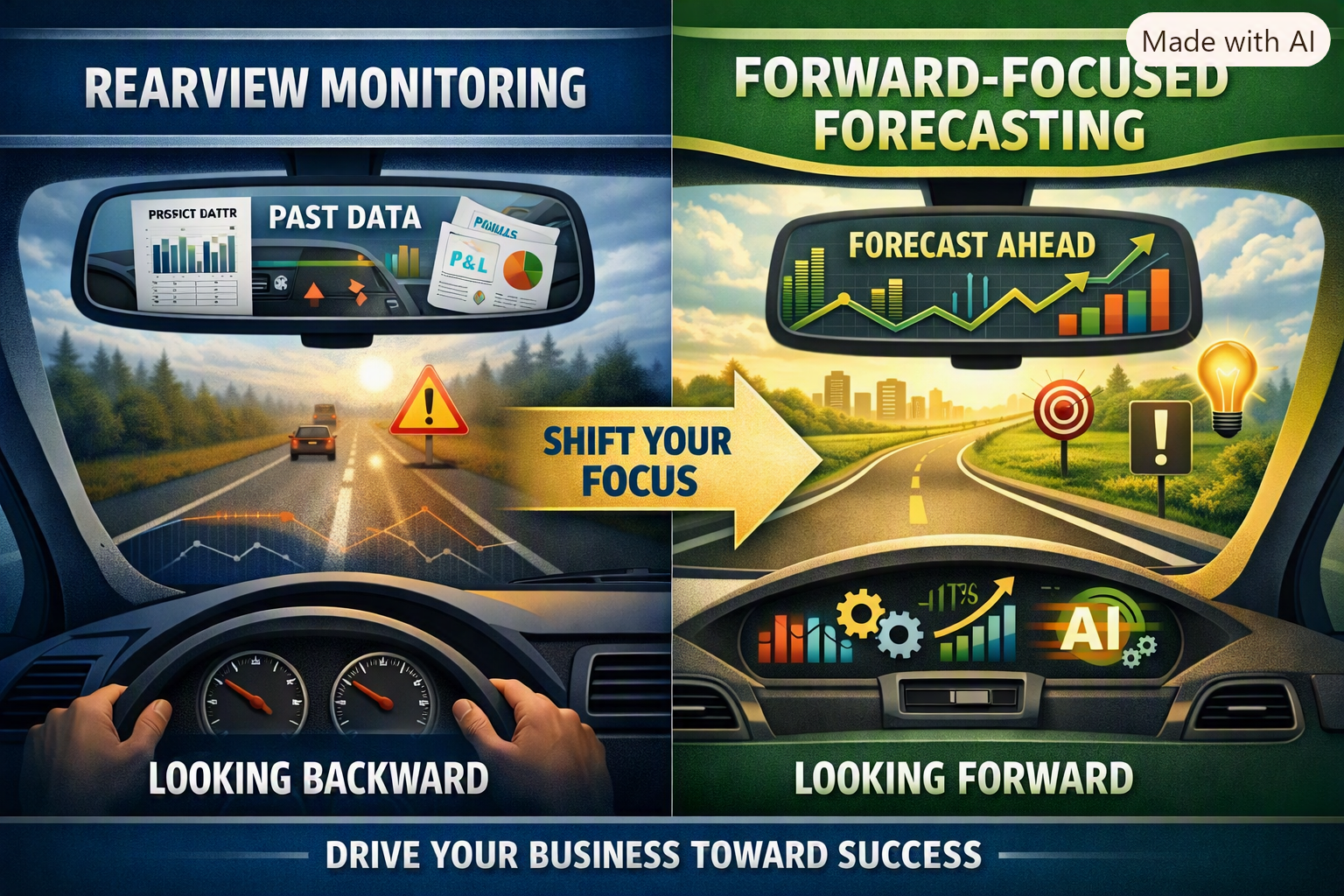
Consider the analogy of driving your car while spending most of your time looking in the rearview mirror. Once in a while you glance at the road in front of you, but you use the rearview mirror or data from the past to project your vehicle down the road. Yes, you may get a general indication that you are staying between the lines on the road, but you have no appreciation for the potential road hazards looming ahead. The question is – is this a best practice for your business?
In manufacturing, additional quality-control data capture points help collect and identify when a process is trending out of standards, etc. This approach allows the process controller to take action earlier and reduce downstream impact on production quality. This leading indicator helps avoid faulty production, reduce waste, and provide a standard quality deliverable to the marketplace. This fundamental approach adds significant profit to the business’s bottom line.
If it is that valuable, why do so many businesses continue to move forward looking only at what happened?
The first step is to make part of your business operation forecast-oriented. Like being sales-oriented, setting your organization on the path to using forecasts as a key problem-solving tool will shift how people and teams coordinate to achieve end objectives. When you shift from looking primarily in the rearview mirror to eyes focused forward, your business’s profitability improves, and you can apply resources more tactically and strategically ahead of the potential challenges every business encounters.
By adopting a model that forecasts across various areas of your business, you will have a better chance of solving challenges before they require immediate reaction and more expensive solutions. The initial challenge is getting a trustworthy forecasting collection and projection system in place. This isn’t as simple as typing a command to generate a new report. It requires a strong commitment to developing key metrics and the people responsible for collecting and anticipating data trends. Problem-solving using the data is best used once the collective has confidence in it.
As we continue to move forward and integrate technologies such as AI, forecasting may become more mainstream. But for AI output to be valuable, the input must be timely and accurate. This is where culture, people, and processes must be future-focused on capturing leading indicators, not just what happened.
This week, as you analyze next steps to improve your organization, consider where forecast problem-solving can play an important role and how you can begin integrating it as a normal part of growing your business.
Need a Promise Guide to walk alongside your forecasting efforts? Call JKL Associates at MI (313) 527-7945 or FL (407) 984-7246.
Journey On!
COPYRIGHT – JKL ASSOCIATES 2026
QUESTIONS OR COMMENTS – EMAIL US AT PARTNERS@JKLASSOCIATES.COM OR CALL OUR OFFICES – MI AT (313) 527-7945 FL AT (407) 984-7246
Celebrating 30 years of Delivering on “Promises”

