

With a long background in ERP implementation, project management, and control systems, it is intriguing to uncover what people think planning is all about and possibly why so many choose not to plan because it is going to change.
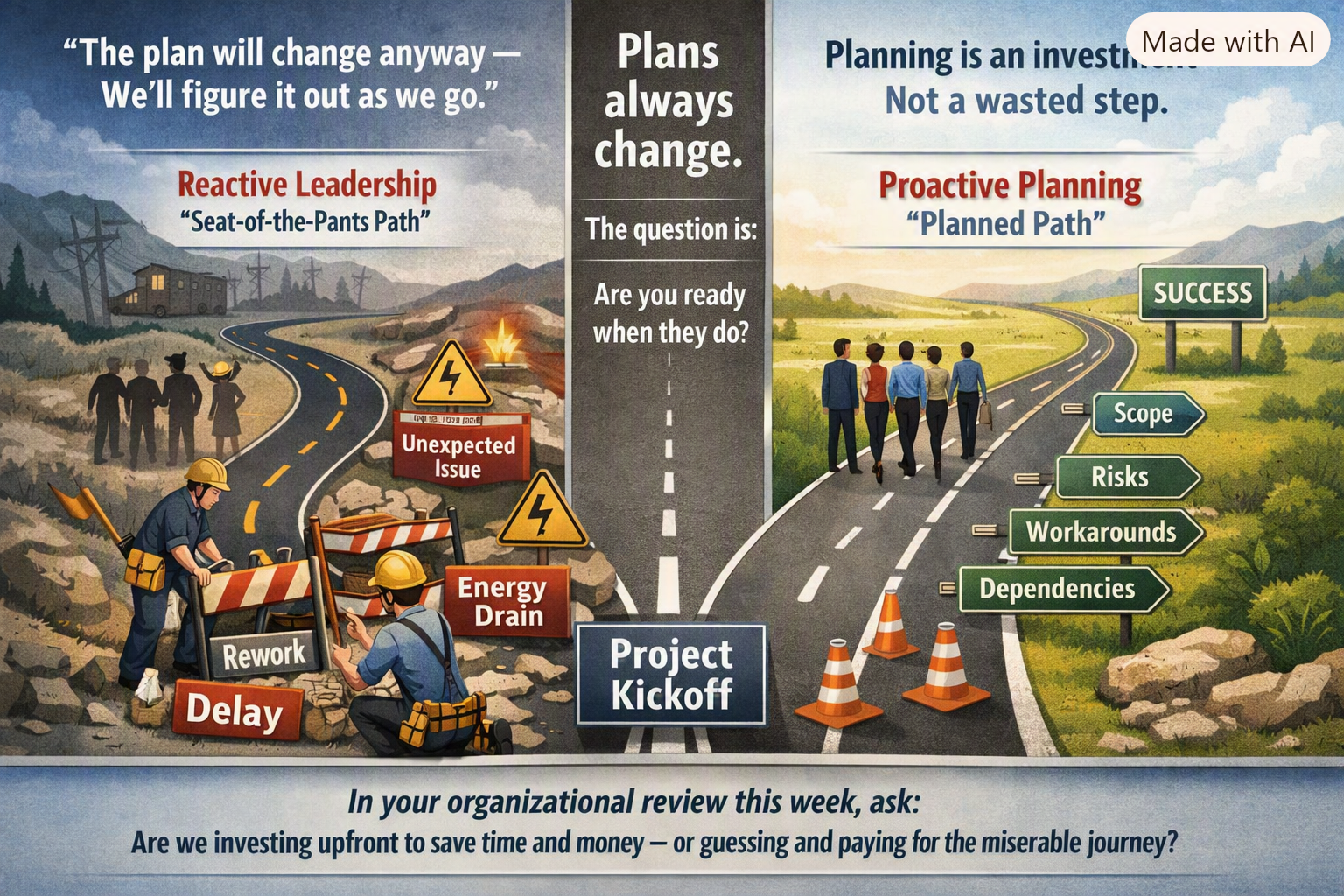
Planning and the energy and effort invested in it should be a high priority for all business leaders and anyone who is leading the way to a greater outcome. It sounds so simple, and one might just take it for granted that everything gets planned out in business. Well, here is the real news – many business leaders consciously choose to fly by the seat of their pants on many things. They have convinced themselves that no matter what roadblock or obstacle shows up in their path, they have a means to work around it. I’ve personally witnessed this, and the creativity to work around issues has been amazing. At the same time, because of the lack of planning, choices made in the midst of the challenge often create more and different issues, increasing the need for further deviation to reach the original end objective.
In some cases, leadership prides itself so much on this reactionary approach that it almost feels unnatural for them to operate any other way. It gives them a strong sense of accomplishment day after day, knocking down the obstacles as they show up. Unfortunately, the surrounding team takes a huge hit in energy as they swing from one crisis to the next. When confronted, the leader will quip that the plan is going to change anyway, so why waste that time now, since it will be regained further into the project.
There may be value in skipping that upfront planning time, which could be gained during the project as the process moves forward slightly earlier than if a plan had been created. In practice, this vital pre-planning usually identifies many potential challenges and workarounds, so the organization can be ready and ahead of the resolution when and if it is needed. This gains valuable time in the resolution phase of the project rather than dealing with issues as they come up here and there.
In the many years JKL Associates has assisted clients in building their business, it hasn’t happened exactly as initially planned. Even with the most diligent effort to scope out all the major challenges, something always shows up unexpectedly and moves the plan in a different direction. The real value of the plan is realized when it shifts: we have already considered the downstream impacts of the original plan and can revisit decisions to understand how an alteration will affect them. Without this prior planning, we address only the obstacle right in front of us, with minimal attention to the long-term downstream issues.
Planning is a real investment made to hopefully identify the best means and paths to realize an outcome. Planning should not be cut short just because there is an impression the plan is likely to change again. The plan is just that – the roadmap from point “A” to “Z” and all of the detours and lane changes necessary to achieve the initial objective. When everyone on the team knows where and how we are going to get to the end result, when a change happens, everyone can assess the impact on their area of contribution and give real-time feedback, instead of guessing what might be impacted downstream.
In your organizational review this week, consider your planning investments. Are you investing upfront to save valuable time and money in the long run, or guessing and hoping for the best outcome only to pay more for that miserable journey?
JKL Associates has a long history of guidance, so now is the time to reach out to Promise Guide for insights. Call JKL Associates at MI (313) 527-7945 or FL (407) 984-7246.
Journey On!
COPYRIGHT – JKL ASSOCIATES 2026
QUESTIONS OR COMMENTS – EMAIL US AT PARTNERS@JKLASSOCIATES.COM OR CALL OUR OFFICES – MI AT (313) 527-7945 FL AT (407) 984-7246
Celebrating 30 years of Delivering on “Promises”

